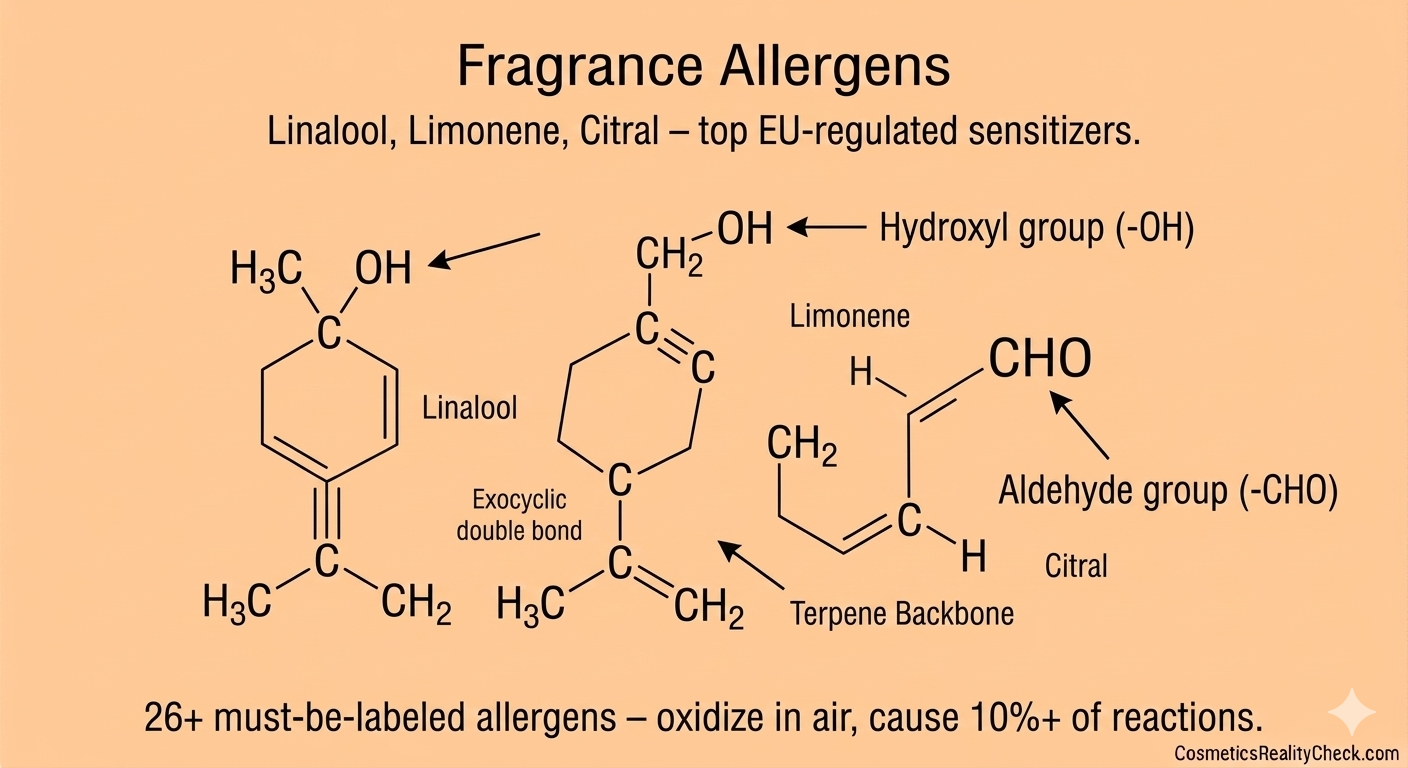
Fragrance allergens are specific aroma compounds that must be declared on cosmetic labels in the EU when they exceed trace levels. Originally 26 compounds identified for their high sensitization potential, this list helps consumers with contact allergies avoid triggers. While the EU expanded labeling requirements in 2023, the original 26 remain the most recognized – here they are with their sources and risks.
What are the 26 EU fragrance allergens?
Under Regulation (EC) No 1223/2009, these must be listed individually if >0.001% in leave-on products or >0.01% in rinse-offs. They occur naturally in essential oils or synthetically in perfumes.
| Allergen (INCI) | Source/Type |
|---|---|
| Amyl Cinnamal | Jasmine-like synthetic |
| Amylcinnamyl Alcohol | Lily of the valley scent |
| Anisyl Alcohol | Anise/licorice note |
| Benzyl Alcohol | Preservative + almond scent |
| Benzyl Benzoate | Fixative, balsamic odor |
| Benzyl Cinnamate | Balsam/styrax aroma |
| Benzyl Salicylate | Fixative, floral note |
| Cinnamal | Cinnamon aldehyde |
| Cinnamyl Alcohol | Cinnamon/hyacinth scent |
| Citral | Lemon/lemongrass (geranial+neral) |
| Citronellol | Rose/geranium oil component |
| Coumarin | Hay/sweet vanilla scent |
| Eugenol | Clove/carnation aroma |
| Evernia Furfuracea Extract | Oakmoss (lichen) |
| Evernia Prunastri Extract | Oakmoss lichen |
| Farnesol | Lily of the valley |
| Geraniol | Rose/palmarosa oil |
| Hexyl Cinnamal | Jasmine-like synthetic |
| Hydroxycitronellal | Muguet (lily) synthetic |
| Hydroxyisohexyl 3-Cyclohexene Carboxaldehyde | Lyral (banned 2019) |
| Isoeugenol | Spicy carnation note |
| Linalool | Lavender/citrus terpene |
| Alpha-Isomethyl Ionone | Violet/woody synthetic |
| Limonene | Citrus peel terpene |
| Alpha-Pinene, Beta-Pinene | Pine/essential oils |
Why these 26 specifically?
Selected based on patch test data showing highest dermatitis rates. Linalool, limonene and geraniol lead due to ubiquity in “natural” fragrances. Oakmoss extracts cause 20% of fragrance allergies despite low usage.
Common reactions and who should avoid
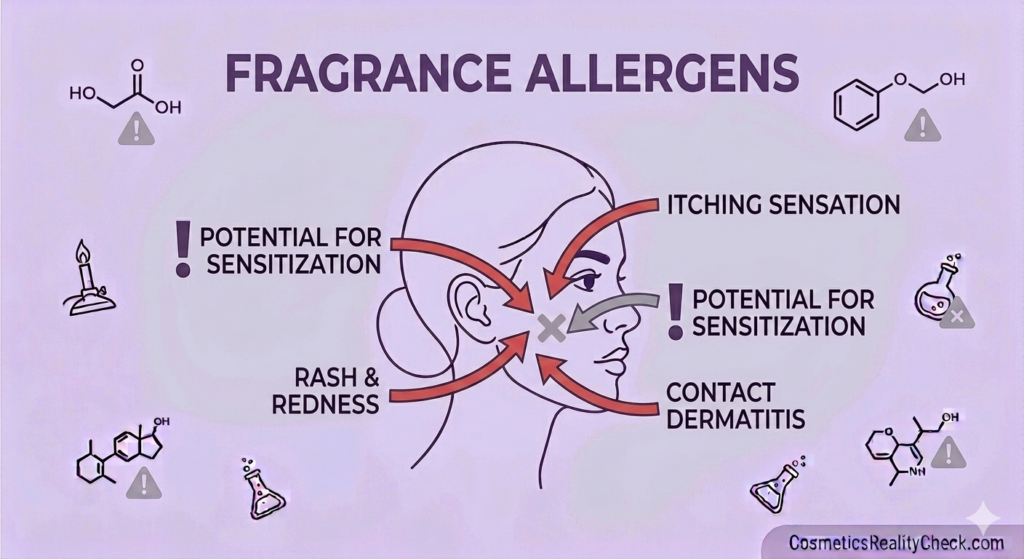
- Contact dermatitis: Redness, itching (face/neck most affected).
- Photosensitivity: Citral, furocoumarins worsen with sun.
- High-risk groups: Eczema patients, children, fragrance-sensitive.
How to spot and avoid fragrance allergens
- Check INCI for the 26 names above threshold levels.
- Choose “fragrance-free” or “unscented” (not “no added fragrance”).
- Patch test leave-ons; rinse-offs safer.
- Note 2023 EU expansion adds 45+ allergens (implementation 2026-2028).
Bottom line
The EU’s 26 fragrance allergens represent highest-risk compounds – now expanding to 70+. Sensitive skin? Scan labels or stick to verified fragrance-free. Most tolerate low levels fine, but declaration empowers avoidance without banning beloved scents entirely.